
Second Phase of OneNet’s 400G Network Connects Oklahoma’s Research Universities
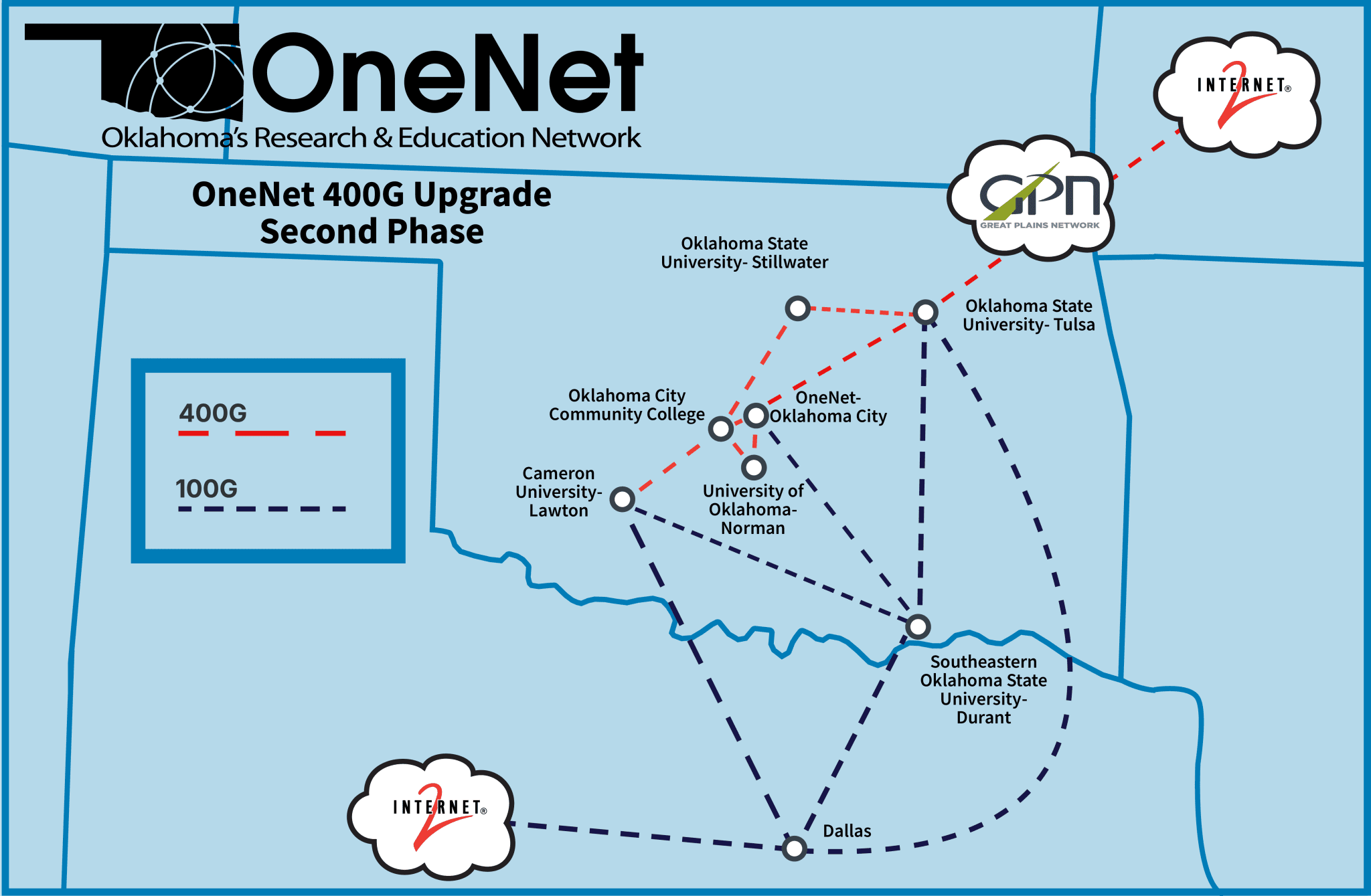
OneNet’s engineering team has completed the second phase of our 400G network upgrade. This phase connects Oklahoma’s largest research universities—Oklahoma State University and University of Oklahoma to OneNet’s new 400G network backbone.
The 400G connections to these two campuses will support the increasing research computing requirements for faculty and researchers. The expanded capacity will provide space for future growth in research traffic for our largest universities.
OneNet’s network team began the upgrade earlier this year to increase the amount of traffic that can travel across the network and boost network speed for subscribers.
“We designed the network upgrade to support our subscribers’ growing bandwidth requirements, especially our higher education institutions,” said Drew Graham, OneNet’s senior network architect. “Not only are we ready to support OU’s and OSU’s current bandwidth growth, we are positioned to increase our network backbone bandwidth exponentially in the near future if required.”
University of Oklahoma
The initial driving forces for the upgrade were OU’s participation in the ATLAS high-energy physics experiment at CERN and the new OAK supercomputing system that will be housed at OSU.
“The ATLAS experiment generates PetaBytes of data every year, and as a Tier2 Computing Center, OU receives hundreds of TB a month delivered to process on Schooner,” said Dr. Horst Severini, computing coordinator for OU’s High Energy Physics Group. “We are about to replace our old 700 TB XRootD storage, which is connected to the world via a dual 25 Gbps data transfer node (DTN), with 1 PB of OURdisk ceph storage, which will be reachable from the outside world via 2 100 Gbps connected DTNs. With this new storage setup, we expect to be able to exceed 100 Gbps total throughput, so we look forward to being able to use OneNet’s new 400 Gbps link.”
Oklahoma State University
The new OAK supercomputer at OSU will elevate the research capabilities of the state and provide computational and data storage resources for researchers in Oklahoma, Arkansas and Kansas (OAK). Able to process immense amounts of data at once, the OAK supercomputer will be the largest in Oklahoma and several nearby states. The new technology will make OSU the leader in supercomputing for the OAK region. The supercomputer will utilize OSU’s new 400G connection to OneNet to transfer data for participating researchers.
OneNet’s new 400G network backbone will support the ever-increasing volume of data that OU and OSU transfer across the state and around the world for these two initiatives.
Future Network Growth
Planning for the 400G upgrade started over a year ago, and OneNet has been running proof-of-concept tests since late October. Since the 400G standards have matured, the cost for equipment has become more affordable, making it cost-effective for OneNet to run 400G across the network. Looking to the future, this new equipment will enable OneNet to eventually support upgrades to 800G and 1.6T as technology evolves over the coming years.
The next phase of the project will deploy 400G connections at Cameron University, which will facilitate OneNet subscriber traffic to Dallas, a major internet exchange hub where OneNet connects with other regional and national networks.
“Oklahoma’s research universities are leading the way in research computing in areas such as high-energy physics, weather prediction, bioinformatics, biology, physics, pharmaceuticals, genomics, seismic imaging, agriculture and cybersecurity,” said John Hennessey, associate vice chancellor for Information Technology and OneNet and Oklahoma’s higher education CIO. “Building capacity to support these initiatives is a priority for OneNet. We will continue to grow our network to ensure the success of our state’s brightest researchers.”
Read about the first phase of the network upgrade!